

Chimney Repairs in Telford
Chimney stacks repointed, rebuilt and flashed in properly by a team that does the brickwork and the roofing, not one or the other. Half an hour west, strongest on the east side.
Chimney Repairs for Homes in Telford
Chimneys split east Telford by era. The new-town estates barely bothered with them, slim decorative flues at most, whose builder-grade flashings are the usual small fix, while the old coalfield villages carry proper Victorian stacks over their terraces, worked hard through the mining decades and now overdue the classic package, repoint, recast, cap, re-lead.
We cover Telford and the surrounding area: Priorslee, St Georges, Snedshill, Oakengates edge, Redhill and beyond (TF2, TF3).
Get a Free Telford Quote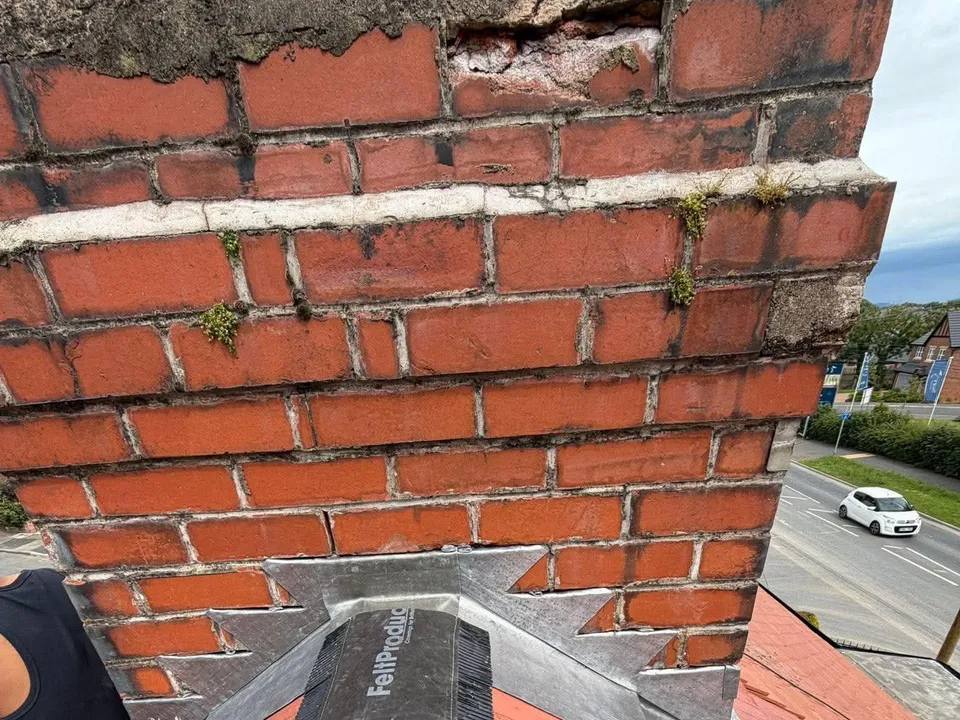
What’s Included
We serve both ends, quick modern-flue details upgraded in real lead, and the St Georges and Oakengates stacks rebuilt or preserved in matched brick as the bricklayers we are. Dead terrace stacks get the honest removal-versus-retention numbers, as everywhere.
- Stacks repointed with the right mortar mix
- Full and partial chimney rebuilds in matching brick
- Lead flashing and soakers renewed, dressed into the joints
- Flaunching recast, pots reset, cowls and caps fitted
- Disused chimneys removed and tiled over
- Roofer and bricklayer on the same scaffold
How It Works
Chimney Repairs in Telford, FAQs
Small one, usually, the factory flashing kits fitted to those flues age poorly and renewing the detail in proper lead ends it. It is an hours job, not a scaffold saga.
At that vintage, expect a deep repoint, fresh flaunching, caps on the dead flues and renewed flashing, the full classic package. It resets the stack for decades and costs far less than the rebuild that neglect eventually writes.
From the ground, look for gaps and shadows in the mortar joints, white staining, or a stack that reads crooked against the sky. Inside, damp patches on the chimney breast are the big tell. Binoculars from the garden will tell you a lot, and we will confirm properly from a ladder or scaffold.
It can be. Stacks lean when the mortar on the weather side wears faster, and a badly leaning stack in wind is a genuine risk to whatever is below. If yours has a visible lean, get it looked at soon. Making it safe is quick; rebuilding it is planned work, not an emergency, if caught early.
Usually the lead. Flashing that has split, lifted or been bodged with mastic lets water straight in at the joint between stack and roof. Cracked flaunching on top does the same. Both are standard fixes for us, and we check all three, brick, flaunching and lead, whenever we look at a leaking chimney.