

Chimney Repairs in Sedgley
Chimney stacks repointed, rebuilt and flashed in properly by a team that does the brickwork and the roofing, not one or the other. Fifteen minutes down the A459.
Chimney Repairs for Homes in Sedgley
A chimney on the Sedgley ridge lives a harder life than almost any other masonry we look after, full wind load, driven rain on every face, and frost that visits early and leaves late. Stacks here lose their mortar years before identical stacks downhill, and a Sedgley chimney check every few years is genuinely worthwhile maintenance rather than fussing.
We cover Sedgley and the surrounding area: Bull Ring area, The Beacon side, Cotwall End, Upper Gornal, Lower Gornal and beyond (DY3).
Get a Free Sedgley Quote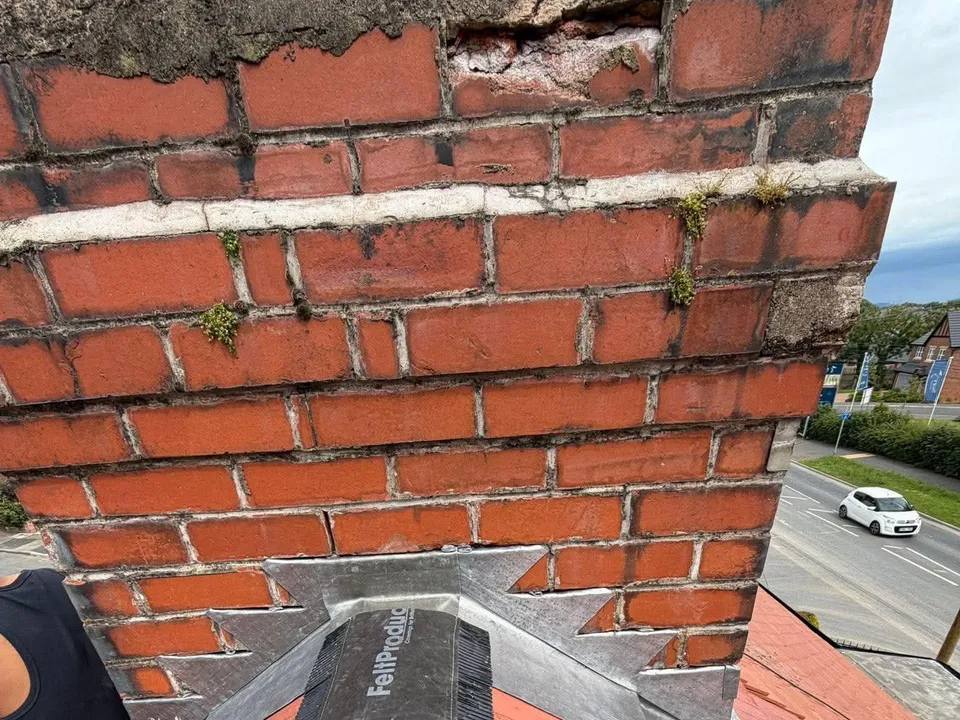
What’s Included
We repoint with mixes that suit each stack’s age, rebuild where the top courses have given up, recast flaunching, and cap retired flues, with everything fixed and flashed for the exposure. On the stone cottages toward the Gornals, stone stacks get pointed as stone should be, not smeared in cement.
- Stacks repointed with the right mortar mix
- Full and partial chimney rebuilds in matching brick
- Lead flashing and soakers renewed, dressed into the joints
- Flaunching recast, pots reset, cowls and caps fitted
- Disused chimneys removed and tiled over
- Roofer and bricklayer on the same scaffold
How It Works
Chimney Repairs in Sedgley, FAQs
On this ridge, every three to five years is sensible, roughly twice as often as a sheltered site. The check is quick and cheap; what it prevents, a rebuilt stack or a soaked chimney breast, is neither.
Yes, stone stacks are part of the local heritage and we point and rebuild them with appropriate mortar and matched stone. It is exactly the sort of masonry-plus-roofing job our name is meant to describe.
From the ground, look for gaps and shadows in the mortar joints, white staining, or a stack that reads crooked against the sky. Inside, damp patches on the chimney breast are the big tell. Binoculars from the garden will tell you a lot, and we will confirm properly from a ladder or scaffold.
It can be. Stacks lean when the mortar on the weather side wears faster, and a badly leaning stack in wind is a genuine risk to whatever is below. If yours has a visible lean, get it looked at soon. Making it safe is quick; rebuilding it is planned work, not an emergency, if caught early.
Usually the lead. Flashing that has split, lifted or been bodged with mastic lets water straight in at the joint between stack and roof. Cracked flaunching on top does the same. Both are standard fixes for us, and we check all three, brick, flaunching and lead, whenever we look at a leaking chimney.